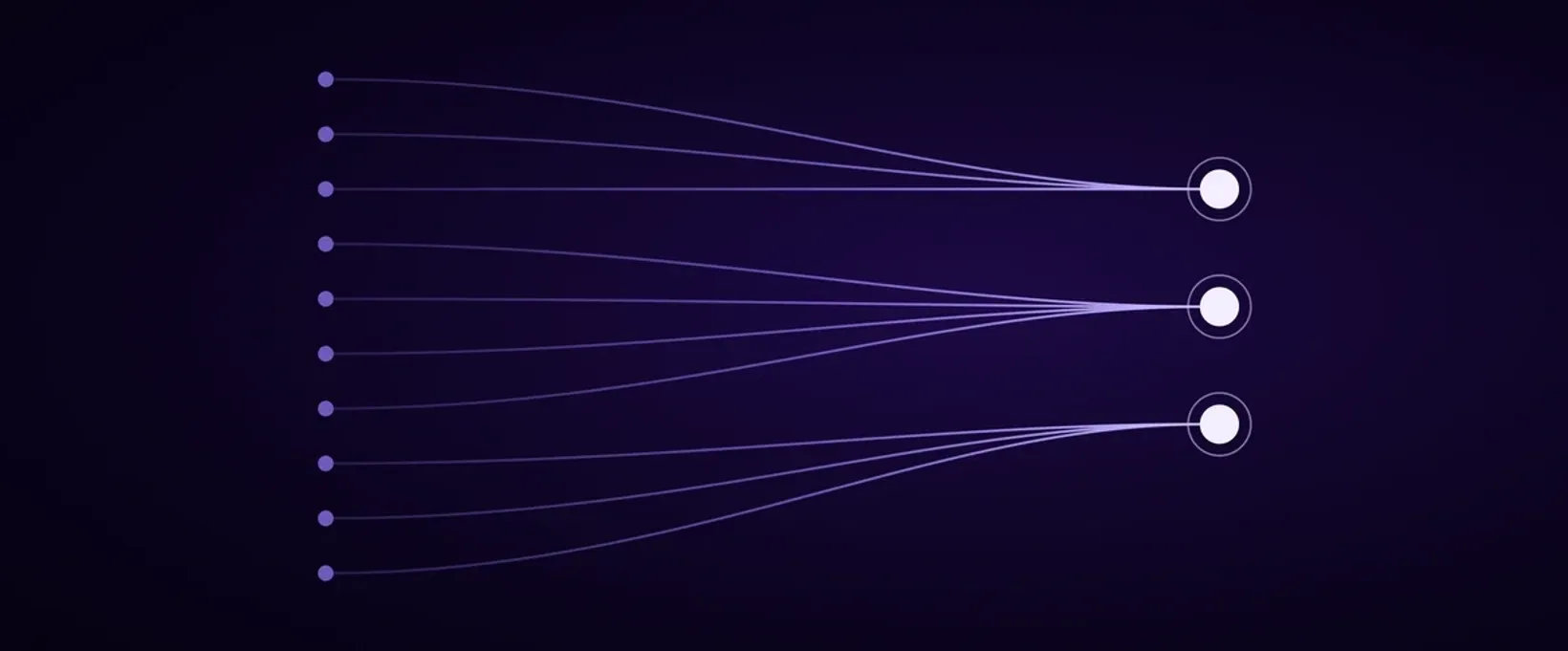
Product teams are getting smaller. They are not going away.
Not long ago, the making of a single software product was a small municipal government. Picture the standing Tuesday meeting. Eight to ten people arrange themselves around a conference table or a Zoom grid. A product manager narrates the roadmap. Two frontend engineers and two backend engineers negotiate over an API contract. A designer shares a Figma link that half the room has not opened. A QA analyst raises a regression from the last release. A scrum master keeps time. Somewhere, a project manager takes notes that will be summarized, circulated, misread, and clarified in a follow-up meeting scheduled for Thursday.
None of this was dysfunction. It was the system working as designed. Software was expensive to produce, so companies rationed it with process. Tickets existed so that intent could survive the journey from a business stakeholder's head to an engineer's keyboard. Standups existed because eight people cannot hold a shared picture of a product without daily synchronization. The ad hoc meetings, the notes sent back and forth, the endless information sharing: all of it was the coordination tax a team paid for splitting one product across ten specialized brains. The tax was worth paying, because there was no alternative.
Now there is.
The great compression
AI has not eliminated the work of building products. It has compressed the execution layer of nearly every role at once, and that simultaneity is what makes this moment different from previous waves of tooling. Compilers made assembly programmers more productive. Frameworks made web developers more productive. AI makes the frontend engineer, the backend engineer, the designer, the ticket writer, and the tester more productive in the same year, using the same underlying capability.
The result is not that these roles disappear. It is stranger than that. They converge.
Consider the frontend engineer and the designer. Both have always thought in terms of the user. Both obsess over interfaces, states, and flows. Historically they were separated by a translation gap: the designer produced pictures of software, and the engineer turned pictures into software. AI closes that gap. When a model can generate a working interface from a well-formed prompt, the picture and the product become the same artifact. What remains is one role, not two: a person who directs the generation and judges the result. The job is to know what good looks like and to catch the places where the machine's competent output is subtly wrong.
The same convergence is happening on the other side of the stack. Backend engineers have always thought in requirements, whether they called them that or not. Contracts, invariants, edge cases, and failure modes are simply acceptance criteria written in a different dialect. Product execution, the half of product management concerned with turning intent into buildable specifications, speaks the same language from the opposite direction. Put an AI between them that drafts the tickets, writes the acceptance criteria, and generates the implementation, and the two roles collapse into one: a person who writes the prompts, verifies that the requirements are the right requirements, and confirms the output fulfills them.
Quality assurance undergoes the most complete transformation of all. Manual testing cannot survive contact with AI-speed shipping for reasons of simple arithmetic. When code ships ten times faster, a human regression pass becomes mathematically impossible. What replaces it is not a bigger QA team but a loop: agents that continuously test, probe, and validate every build, running as part of the pipeline itself. QA stops being a department and becomes a process. The remaining human responsibility is making sure the loop itself is operating correctly, and that responsibility sits with the engineers who own the pipeline.
Then there is product strategy, the one role that AI compresses least. Deciding what should exist, for whom, and why remains stubbornly human work. But the strategist benefits from everyone else's compression. Freed from shepherding execution, a single strategist can now cover more products, or go deeper on one. Strategy was always the scarcest input in product development. It is about to become the most visible one, because there is far less machinery standing between a strategic decision and shipped software.
The new blueprint
Assemble the converged roles and the shape of the modern product team emerges. Where a product once required eight to ten people, it now requires roughly three.
The first is a design-side builder, the fusion of frontend engineering and product design. This person owns everything the user sees and touches, prompting the interface into existence and applying taste to the result.
The second is a systems-side builder, the fusion of backend engineering and product execution. This person owns requirements, data, and logic, directing agents through well-specified tickets and verifying that what comes back honors the contract.
The third is a strategist, likely fractional across products, who decides what is worth building at all.
Beneath all three runs the automated QA loop, testing continuously, with the builders responsible for its health.
The reader will notice some absences. The scrum master is gone, and honestly so, because the ceremonies existed to synchronize many humans, and there are no longer many humans to synchronize. Status is now queryable rather than reported. The traditional project manager largely dissolves into the systems-side role for internal work, though a version survives wherever the work touches the outside world, since launches, vendors, and compliance deadlines still run on human calendars. The dedicated production designer, the ticket-writing product manager, and the manual tester are absorbed into the converged roles rather than eliminated by them. The work did not vanish. It moved into the judgment of fewer, more leveraged people.
What it means for the future
The immediate consequence is economic. If three people can do what ten did, companies face a choice between building the same amount with fewer people or building far more with the same people. History suggests they will choose more. The backlog of software that was never worth building at old prices is enormous. Internal tools, niche products, and experiments that died in prioritization meetings suddenly clear the bar. Product teams will shrink per product and multiply per company.
The second consequence is cultural. Every surviving role in the new blueprint shares a single job description: write the prompt, then check the work. Producing is out. Directing and verifying are in. This inverts what organizations have optimized for over decades. Throughput, the historical measure of a strong engineer or a productive designer, is now nearly free. Judgment, the ability to know what to ask for and to recognize when the answer is wrong, is the scarce commodity. Companies that keep hiring and promoting for throughput will staff themselves with the wrong people at exactly the wrong time.
For individuals, the advice writes itself from the convergence map. Frontend engineers should develop design judgment, because taste is the half of their converged role that machines cannot supply. Designers should learn to ship, because the gap between a mockup and a product is closing from both sides. Backend engineers should learn to own requirements and to communicate with stakeholders, because the specification is becoming their deliverable. Product managers should decide, candidly, which half of their job they actually do. Those who translate intent into tickets are automating themselves. Those who generate the intent are about to have the most leverage of their careers. And anyone in QA should move up the stack from executing tests to designing the loops that execute them.
The deepest change may be the quietest one. For thirty years, the defining constraint of product development was the cost of building, and every role, ritual, and org chart was shaped by that scarcity. That constraint is gone. The new constraint is knowing what to build and whether to trust what was built. The teams of the next decade will be small, but they will not be junior, and they will not be idle. They will be three people holding an entire product in their heads, the way software's earliest builders once did, except with a workforce of machines beneath them.
This is not a prediction for us at Rapptr. It is how we already work. Our teams run on converged roles, agent-driven execution, and automated quality loops, which is why a small team can now ship what once took a department. Most companies will spend years restructuring toward this model. The shortcut is working with a team that is already built for it.
The meeting of ten is over. The product, at last, gets everyone's full attention.